


Businesses of every size are now learning how to use AI tools to automate your business tasks without needing technical expertise.A lot of business owners don’t realize how much time disappears into tiny repetitive tasks until they finally stop doing them.
The constant email replies. Scheduling meetings. Updating spreadsheets. Writing social media captions. Following up with leads. Organizing notes nobody reads later.
Individually, those tasks feel small. Together? They quietly drain hours every single week.
That’s exactly why more companies — from solo freelancers to growing startups — are learning how to use AI tools to automate your business tasks instead of handling everything manually.
And no, this isn’t about replacing humans with robots.
It’s about removing the kind of work that burns people out while freeing up time for strategy, creativity, customer relationships, and actual growth.
The best part? You don’t need a massive budget or technical background to start.
Why So Many Businesses Are Turning to AI
Learning how to use AI tools to automate your business tasks can dramatically improve productivity, reduce repetitive work, and help businesses operate more efficiently. Once companies understand how to use AI tools to automate your business tasks, they often save hours every week while improving customer experience and workflow management.There’s a reason AI automation exploded so quickly.
Most businesses were already overwhelmed before AI tools became mainstream. Teams were juggling too many apps, too many notifications, and too many repetitive processes.
AI stepped into that chaos and offered something valuable: breathing room.
The hidden cost of repetitive work
Think about how many times people repeat the same actions every day:
- Responding to common customer questions
- Writing follow-up emails
- Summarizing meeting notes
- Posting content across platforms
- Sorting incoming data
- Updating CRM records
These tasks usually don’t generate creativity or innovation. They simply keep operations moving.
That’s where AI becomes useful.
Instead of spending three hours writing repetitive emails, AI can draft them in seconds. Instead of manually transferring data between apps, automation tools can handle it instantly.
Those saved minutes add up faster than most people expect.
“AI works best when it removes friction, not when it replaces judgment.”

What Business Tasks Can AI Actually Automate?
One of the biggest misconceptions about AI is that it only works for tech companies.
In reality, almost every business already has processes AI can improve.
1. Customer Support
AI chatbots can answer common questions instantly:
- Shipping updates
- Refund policies
- Appointment scheduling
- Product recommendations
This doesn’t mean eliminating support teams. It means allowing human agents to focus on complex customer issues instead of answering “Where’s my order?” 300 times a day.
2. Email Marketing
AI tools can now:
- Write email subject lines
- Personalize campaigns
- Predict open rates
- Segment audiences
- Suggest send times
For small businesses, this is a massive advantage because marketing often gets delayed when teams are stretched thin.
3. Content Creation
Writers, marketers, and business owners are increasingly using AI to:
- Brainstorm blog ideas
- Create outlines
- Generate captions
- Draft newsletters
- Repurpose long-form content
The smartest businesses don’t publish raw AI output blindly. They use AI as a starting point and add human expertise afterward.
4. Scheduling and Meetings
AI scheduling assistants can:
- Coordinate calendars
- Suggest meeting times
- Send reminders
- Transcribe meetings
- Create summaries automatically
Anyone who has spent 20 back-and-forth emails trying to book one meeting understands how valuable this becomes.
5. Data Entry and Reporting
This is where automation creates immediate impact.
AI can extract information from invoices, organize spreadsheets, generate reports, and move data between systems automatically.
It’s not glamorous work, but it saves enormous amounts of time.
Best Ways to Use AI Tools to Automate Your Business Tasks
A common mistake businesses make is trying to automate everything immediately.
That usually creates confusion instead of efficiency.
A better approach is surprisingly simple.
Start With One Painfully Repetitive Task
Ask yourself:
“What task do I repeat so often that I could almost do it with my eyes closed?”
That’s your starting point.
Good beginner automation examples include:
- Email replies
- Social media scheduling
- Meeting summaries
- Lead follow-ups
- Invoice processing
Start small. Build confidence. Expand gradually.
Choose Beginner-Friendly AI Tools
Some tools are incredibly powerful but unnecessarily complicated for beginners.
If you’re just starting, prioritize ease of use over advanced features.
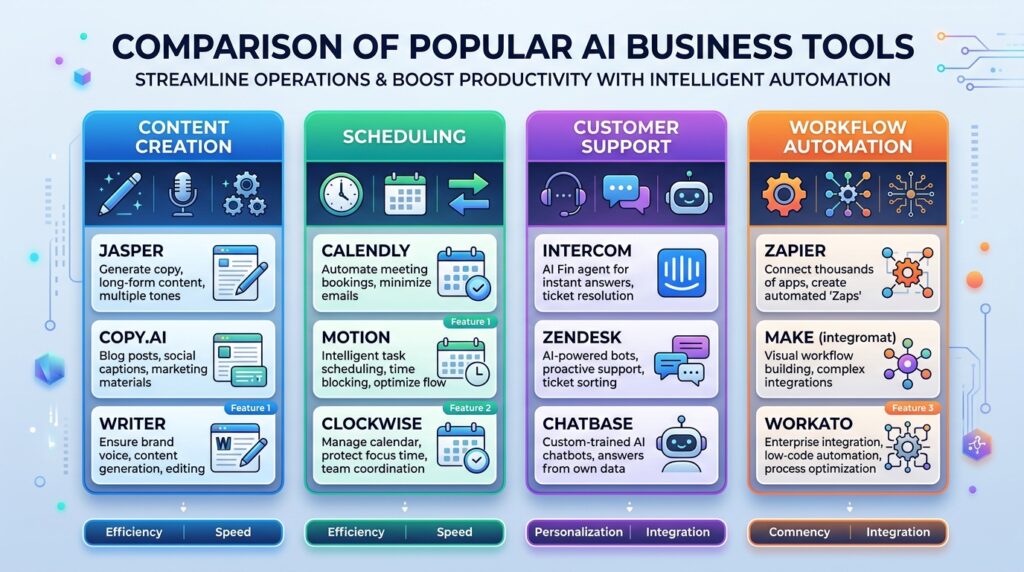
Here are a few beginner-friendly options:
| Tool | Best For |
| ChatGPT | Writing, brainstorming, customer support drafts |
| Zapier | Connecting apps and automating workflows |
| Notion AI | Productivity and organization |
| Grammarly | Editing and communication |
| HubSpot AI | Marketing and sales automation |
Measure Time Saved
This step is important because AI success isn’t just about using fancy tools.
It’s about measurable improvement.
Track things like:
- Hours saved weekly
- Faster response times
- Reduced manual errors
- Increased output
- Improved customer satisfaction
Businesses often discover that even one small automation saves several hours every month.
Best AI Tools for Business Automation
Let’s talk about practical tools businesses are actually using right now.
ChatGPT
OpenAI created ChatGPT primarily for conversational AI, but businesses quickly realized its productivity potential.
Companies use it for:
- Writing emails
- Drafting content
- Brainstorming ideas
- Summarizing meetings
- Customer support responses
Used correctly, it feels less like a replacement and more like an incredibly fast assistant.
Zapier
Zapier is one of the easiest ways to automate repetitive workflows without coding.
For example:
- Save Gmail attachments automatically to Dropbox
- Add leads from Facebook ads into CRMs
- Send Slack alerts for sales notifications
It quietly handles thousands of repetitive tasks in the background.
Notion AI
Notion combines note-taking, project management, and AI assistance in one workspace.
Teams use it to:
- Summarize documents
- Organize projects
- Generate action items
- Improve collaboration
HubSpot AI
HubSpot helps businesses automate marketing, customer communication, and lead nurturing.
This becomes especially valuable as businesses grow and customer interactions multiply.
Grammarly
Grammarly is more than spellcheck now.
Businesses use it for:
- Tone improvement
- Professional communication
- Faster editing
- Clearer messaging
Simple? Yes. Helpful? Absolutely.
Artificial Intelligence Insights & Articles | QuantumBlack | McKinsey & Company
Real Examples of AI Automation in Action
A Small Business Owner
A local online store owner used AI to automate:
- Customer inquiries
- Order tracking updates
- Email campaigns
The result wasn’t just saved time.
It allowed them to focus on product development and customer experience instead of constantly answering repetitive questions.
A Marketing Team
One marketing agency started using AI for first-draft content creation and meeting summaries.
Instead of replacing writers, it reduced time spent on low-value prep work.
The team reported faster turnaround times without sacrificing quality.
A Freelancer
A freelance consultant used automation for invoicing, scheduling, and proposal generation.
That reduced admin work significantly and created more billable hours every week.
Sometimes the biggest value of AI isn’t dramatic innovation.
It’s simply reducing mental clutter.

Common Mistakes When Using AI Tools to Automate Your Business Tasks
AI can absolutely improve efficiency.
But there are also mistakes that create frustration instead of results.
Automating Broken Processes
If a workflow is already confusing, AI won’t magically fix it.
Automation works best after simplifying the process first.
Ignoring Human Review
AI still makes mistakes.
Businesses should always review:
- Important emails
- Sensitive customer communication
- Financial reports
- Public-facing content
Human judgment still matters.
Using Too Many Tools Too Quickly
This happens constantly.
A business signs up for eight AI tools in one week and suddenly nobody knows which system does what.
Start lean.
One useful automation is better than ten chaotic ones.
Pro Tips for Smarter AI Automation
Here’s what experienced businesses tend to do differently:
Focus on Repetitive Tasks First
Don’t automate creativity before automating repetition.
Build Simple Workflows
Complex systems often break faster.
Train Your Team Properly
Even great tools fail when teams don’t understand them.
Review Results Regularly
Automation should improve over time, not run unchecked forever.
Keep the Human Touch
Customers still value empathy, personality, and genuine interaction.
AI should support relationships — not remove them.
Frequently Asked Questions
Is AI automation expensive for small businesses?
Not necessarily. Many AI tools offer free or affordable plans designed for small teams and solo entrepreneurs.
Do I need coding skills to automate business tasks?
No. Many modern AI platforms are built for non-technical users.
What is the best AI tool for beginners?
ChatGPT and Zapier are excellent beginner-friendly options because they’re flexible and easy to learn.
Can AI replace employees?
AI usually works best as a productivity assistant rather than a complete replacement for human workers.
Is AI automation secure?
Most reputable AI platforms include security measures, but businesses should still review privacy policies and data handling practices carefully.
How quickly can businesses see results from AI?
Some automations save time immediately, especially in scheduling, customer support, and content workflows.
What business tasks should I automate first?
Start with repetitive, time-consuming tasks like email replies, scheduling, and data entry.
Can AI help small businesses compete with larger companies?
Yes. AI gives small businesses access to productivity tools that were once only available to large enterprises.
Is AI difficult to learn?
Most beginner-friendly AI tools are surprisingly easy to use with minimal training.
Will AI reduce operational costs?
In many cases, yes. Automation can lower labor hours, reduce mistakes, and improve efficiency.
What industries benefit most from AI automation?
Retail, marketing, customer service, healthcare, finance, and eCommerce all benefit significantly.
How do I choose the right AI tool?
Focus on your biggest workflow bottleneck first, then choose a tool specifically designed to solve that problem.
CONCLUSION
Learning how to use AI tools to automate your business tasks isn’t really about chasing trends.
It’s about reclaiming time.
The businesses seeing the biggest benefits from AI aren’t necessarily the largest or most technical ones. They’re the ones willing to remove unnecessary friction from daily work.
Start with one repetitive task.
Automate it thoughtfully.
Measure the impact.
Then build from there.
Over time, those small improvements compound into something bigger: less burnout, better productivity, faster growth, and more space to focus on meaningful work. And honestly, that’s what most business owners wanted all along.
The biggest advantage of learning how to use AI tools to automate your business tasks is gaining back time to focus on growth and creativity.